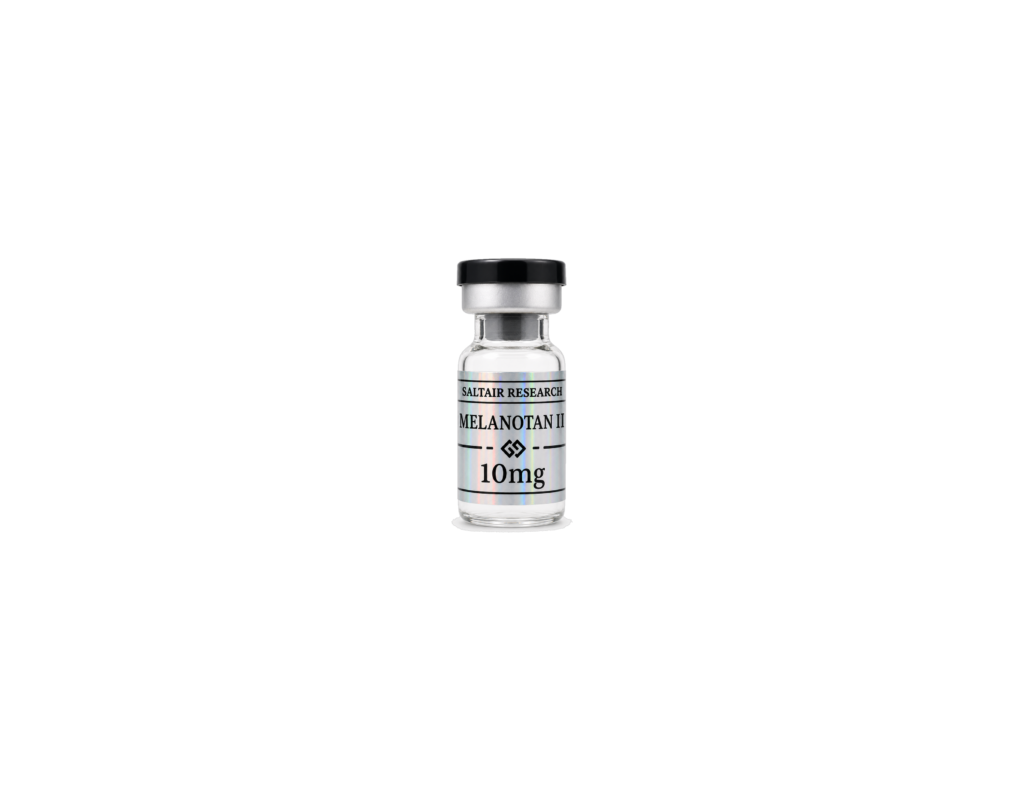
Melanotan II is a synthetic cyclic analog of alpha-melanocyte-stimulating hormone (α-MSH) — a naturally occurring peptide hormone. It is one of the most studied molecules in melanocortin research, and its scientific story is more consequential than most peptides in this library: a compound derived from it became an FDA-approved drug.
What you’re reading about
Melanotan II (often shortened to MT-2) is a non-selective melanocortin receptor agonist — meaning it activates several receptors in the family at once, which is why its research spans such different areas, from pigmentation to appetite to sexual function.
Mechanism under investigation
The melanocortin system runs on five receptors, and Melanotan II engages several:
- MC1R — found on melanocytes; drives melanin synthesis and pigmentation.
- MC3R / MC4R — central receptors involved in appetite, energy balance, and sexual arousal pathways.
- MC5R — associated with exocrine gland function.
This breadth is both the interest and the challenge: a single molecule touching several receptor subtypes produces a wide range of effects, which is exactly what drove the development of more selective successors.
Research applications
- Melanogenesis and photoprotection research via MC1R.
- Appetite and energy-balance signaling via MC4R.
- Neuroendocrine and sexual-function pathways.
- Structure-activity work aimed at building receptor-selective analogs.
Clinical outlook
This is where melanocortin research becomes genuinely notable. Melanotan II itself is in active human study — a Phase 2 trial is recruiting to evaluate it as an adjunct to NB-UVB phototherapy (NCT07437560). More importantly, the wider class has already crossed the finish line: bremelanotide, a melanocortin agonist developed out of Melanotan II research, completed Phase 3 trials (NCT02333071, NCT02338960) and was approved by the FDA in 2019. Separately, afamelanotide — another α-MSH analog — was approved for erythropoietic protoporphyria after its own Phase 2/3 program (NCT01097044). Few research peptides can point to two approved drugs emerging from their pharmacology; that is the strongest possible argument for continued melanocortin investigation.
Frequently asked questions about Melanotan II
Straight answers to the questions researchers most often ask. Everything below summarizes published preclinical and clinical literature; it is not medical advice, and these compounds are supplied for laboratory research only.
What is Melanotan II?
Melanotan II (MT-2) is a synthetic cyclic heptapeptide analog of alpha-melanocyte-stimulating hormone. It is a non-selective melanocortin-receptor agonist, best known for stimulating skin pigmentation, and its pharmacology gave rise to two FDA-approved drugs.
What does Melanotan II do?
It activates melanocortin receptors MC1R through MC5R. MC1R activation increases melanin production (tanning); MC3R/MC4R activation affects appetite and sexual arousal, which is how the erectile-dysfunction drug bremelanotide was discovered.
Is Melanotan II FDA approved?
No. Melanotan II itself is not approved anywhere. Two drugs derived from melanocortin research are: afamelanotide (Scenesse) for a light-sensitivity disorder, and bremelanotide (Vyleesi) for hypoactive sexual desire disorder.
What is the difference between Melanotan I and Melanotan II?
Melanotan I (afamelanotide) is a linear peptide selective for MC1R — pigmentation only — and is an approved drug. Melanotan II is cyclic, shorter, and non-selective, which gives it the additional appetite and sexual effects.
What adverse effects are reported for Melanotan II?
Nausea, flushing, spontaneous erections, darkening of existing moles and new moles are the effects most frequently reported in the literature and in regulatory warnings. Concern about melanoma risk from mole changes is the main reason health agencies warn against unregulated use.
Is Melanotan II being studied clinically?
Yes — a Phase 2 trial is recruiting to evaluate it as an adjunct to narrowband-UVB phototherapy, and the wider melanocortin field has active research in metabolic and sexual medicine.
References
- Melanocortin receptor agonist melanotan-II microinjected in the nucleus accumbens decreases appetitive and consumptive responding for food
- Melanotan II, a melanocortin agonist, partially rescues the impaired thermogenic capacity of pituitary adenylate cyclase-activating polypeptide deficient mice
- Melanocortin receptor agonists, penile erection, and sexual motivation: human studies with Melanotan II
- The potent melanocortin receptor agonist melanotan-II promotes peripheral nerve regeneration and has neuroprotective properties in the rat
- The melanocortin agonist Melanotan-II reduces the orexigenic and adipogenic effects of neuropeptide Y (NPY) but does not affect the NPY-driven suppressive effects on the gonadotropic and somatotropic axes in the male rat