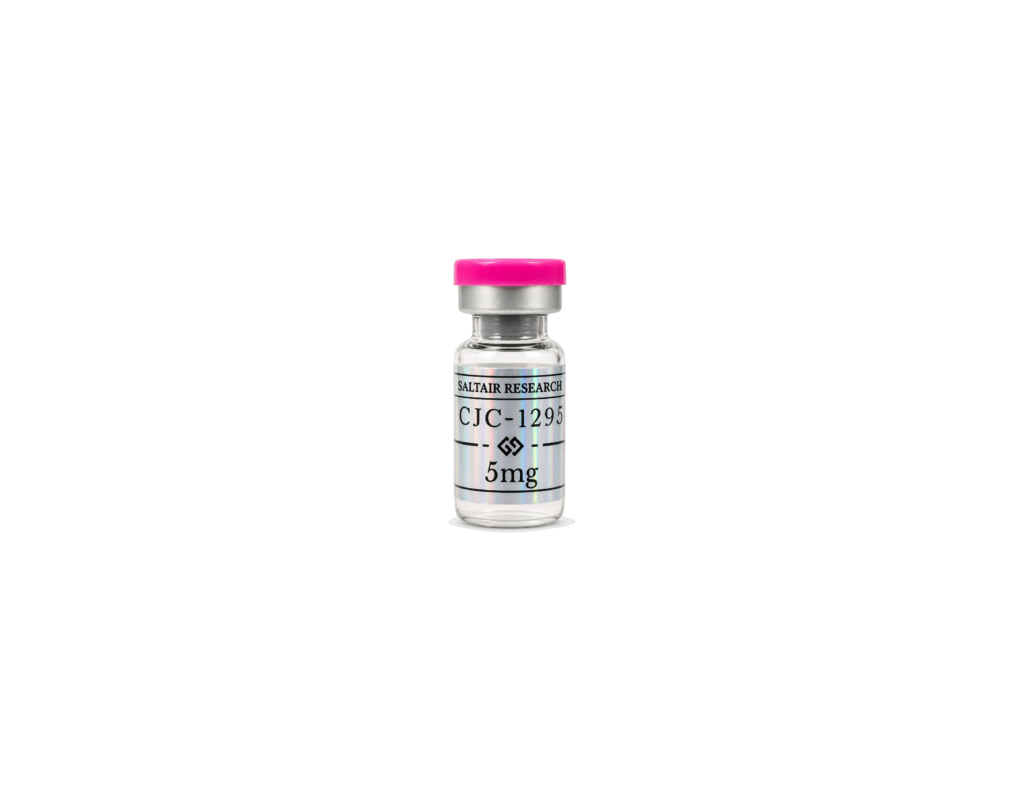
CJC-1295 without DAC is a synthetic 29-amino-acid analog of growth-hormone-releasing hormone. It is studied as a tool for driving the body’s own growth-hormone production — rather than supplying growth hormone directly — and its defining feature is a deliberately short duration of action.
What you’re reading about — with DAC vs. without
This is the single most confused point about this compound, so here it is plainly:
- CJC-1295 without DAC — also called Modified GRF (1-29) or Mod GRF 1-29. Short half-life, producing a brief pulse of GH release. This is the compound profiled here.
- CJC-1295 with DAC — carries a Drug Affinity Complex that binds albumin and extends its half-life to days, producing a sustained elevation instead of a pulse. A different research tool with a different profile.
The distinction matters: the two behave differently enough that findings for one should not be assumed to transfer to the other.
Mechanism under investigation
As a GHRH analog, it binds the GHRH receptor on the pituitary and stimulates release of endogenous growth hormone. Because the no-DAC version clears quickly, the resulting release is pulsatile — closer to the body’s natural rhythm, in which GH is secreted in bursts rather than held at a constant level. That physiological patterning is precisely why researchers reach for it.
Research applications
- GHRH-receptor signaling and pituitary function.
- Pulsatile versus sustained GH release — a direct comparison against the DAC variant.
- Combination research alongside GHRP-class peptides such as Ipamorelin, where GHRH and ghrelin-receptor pathways are studied together.
- Downstream IGF-1 and body-composition markers.
Clinical outlook
Human data on this specific compound is thin, and we would rather say so than overstate it. A Phase 2 trial studied CJC-1295 in HIV patients with visceral obesity but was terminated (NCT00267527), so it did not produce the evidence a completed study would have. The broader GHRH-analog approach, however, is well validated — Tesamorelin, another GHRH analog, completed Phase 3 trials and reached FDA approval. That makes the class credible even where this particular molecule remains early, and it is the gap researchers working with Mod GRF 1-29 are positioned to help close.
Frequently asked questions about CJC-1295 (no DAC / Mod GRF 1-29)
Straight answers to the questions researchers most often ask. Everything below summarizes published preclinical and clinical literature; it is not medical advice, and these compounds are supplied for laboratory research only.
What is CJC-1295?
CJC-1295 is a synthetic 29-amino-acid analog of growth-hormone-releasing hormone (GHRH 1–29) with four amino-acid substitutions that resist enzymatic breakdown. Our product is the "no DAC" form, also called Mod GRF (1–29).
What is the difference between CJC-1295 with DAC and without DAC?
DAC (drug affinity complex) is a lysine-linked group that binds albumin and extends the half-life from minutes to about a week. Without DAC the peptide produces a short, pulse-like GH release; with DAC it produces continuous elevation. They are studied for different questions.
How does CJC-1295 work?
It binds the pituitary GHRH receptor and stimulates release of the body's own growth hormone, raising IGF-1 downstream. It does not supply growth hormone directly.
Has CJC-1295 been tested in humans?
Only in limited studies. A Phase 2 trial in HIV-associated visceral obesity was terminated before completion, and early pharmacokinetic studies exist for the DAC form. Human data on the no-DAC form specifically is thin.
Is CJC-1295 FDA approved?
No. It is supplied for laboratory research only. Tesamorelin is the GHRH analog that did complete development and win approval.
Why is CJC-1295 paired with Ipamorelin in research?
Because GHRH-receptor and ghrelin-receptor stimulation are additive: Ipamorelin triggers the pulse, CJC-1295 amplifies it. The pairing is one of the most common designs in growth-hormone-axis research.
References
- Prolonged stimulation of growth hormone (GH) and insulin-like growth factor I secretion by CJC-1295, a long-acting analog of GH-releasing hormone, in healthy adults
- Activation of the GH/IGF-1 axis by CJC-1295, a long-acting GHRH analog, results in serum protein profile changes in normal adult subjects
- Pulsatile secretion of growth hormone (GH) persists during continuous stimulation by CJC-1295, a long-acting GH-releasing hormone analog
- Once-daily administration of CJC-1295, a long-acting growth hormone-releasing hormone (GHRH) analog, normalizes growth in the GHRH knockout mouse
- Advances in the detection of growth hormone releasing hormone synthetic analogs