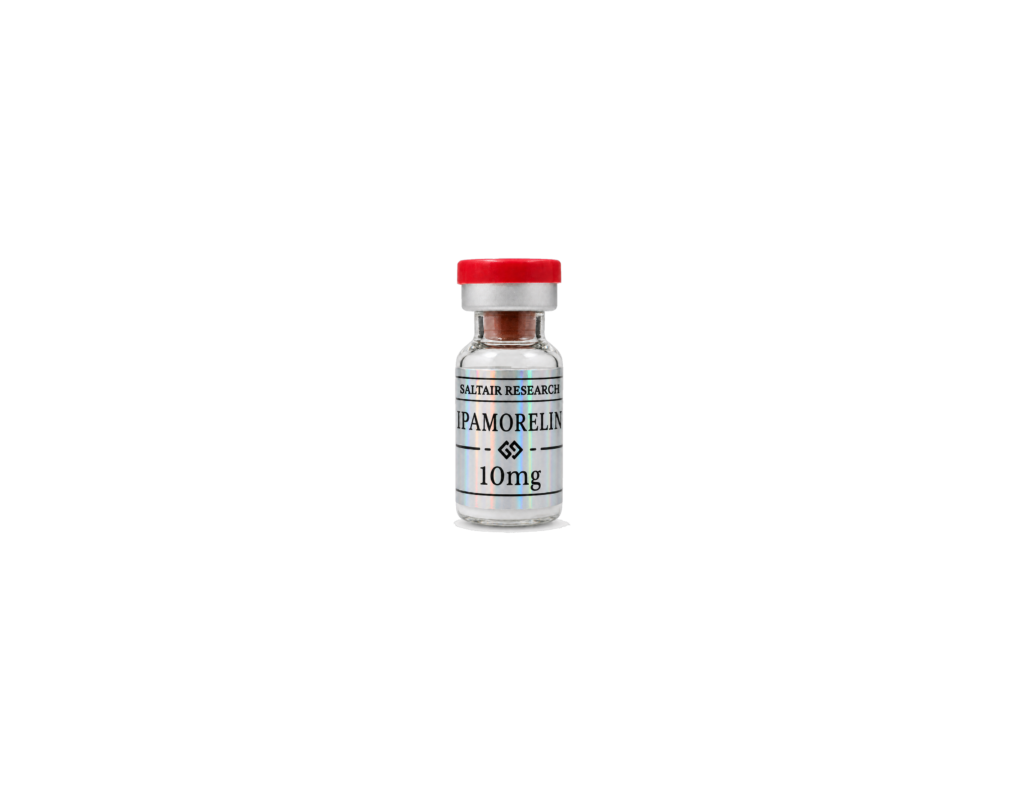
Ipamorelin is a synthetic pentapeptide and one of the most selective growth hormone secretagogues ever developed. It belongs to the GHRP family, but is distinguished in the literature by how cleanly it acts — stimulating growth-hormone release with little of the off-target hormonal noise associated with earlier compounds in its class.
What you’re reading about
Ipamorelin is often described simply as a “GHRP” (growth hormone releasing peptide). Its sequence is Aib-His-D-2-Nal-D-Phe-Lys-NH₂ — just five amino acids, which is part of why it is such a tractable research tool.
Mechanism under investigation
Ipamorelin acts as an agonist at the ghrelin receptor (GHS-R1a), the same receptor the body’s own hunger-and-growth signal uses. Binding there triggers release of growth hormone from the pituitary. What made Ipamorelin notable in the original research is its selectivity: unlike earlier secretagogues, it produces minimal elevation of cortisol, prolactin, or ACTH, giving researchers a cleaner way to isolate GH signaling from stress-hormone effects.
Research applications
- Selective stimulation of pulsatile growth-hormone release.
- Gastrointestinal motility research — ghrelin-receptor agonism affects gut transit.
- Body composition, lean tissue, and recovery endpoints in animal models.
- Bone-density and connective-tissue markers mediated by the GH/IGF-1 axis.
Clinical outlook
Ipamorelin has genuinely reached human research. Two completed Phase 2 trials investigated it in a direction that may surprise people who know it only as a GH peptide: post-operative ileus — the temporary shutdown of gut motility after abdominal surgery (NCT00672074, NCT01280344). That work followed from its ghrelin-receptor activity rather than its growth-hormone effect. Researchers continue to study both arms of its biology: the GH-secretagogue pathway for body composition and recovery, and the motility pathway for gastrointestinal medicine.
Frequently asked questions about Ipamorelin
Straight answers to the questions researchers most often ask. Everything below summarizes published preclinical and clinical literature; it is not medical advice, and these compounds are supplied for laboratory research only.
What is Ipamorelin?
Ipamorelin is a synthetic pentapeptide growth-hormone secretagogue — an agonist of the ghrelin receptor (GHS-R1a) — noted in the original 1998 research for stimulating growth-hormone release with minimal effect on cortisol, prolactin or ACTH.
How does Ipamorelin work?
It activates the ghrelin receptor in the pituitary and hypothalamus, triggering a pulse of growth hormone. Its selectivity — little stress-hormone spillover compared with earlier GHRPs — is what made it a preferred research tool.
Has Ipamorelin been tested in humans?
Yes. Two completed Phase 2 trials studied it for post-operative ileus (the shutdown of gut motility after abdominal surgery), following from its ghrelin-receptor activity. It has not been developed clinically as a growth-hormone therapy.
Is Ipamorelin FDA approved?
No. It reached Phase 2 but has no approved indication and is supplied for laboratory research only.
Ipamorelin vs CJC-1295 — what is the difference?
They act on different receptors: Ipamorelin is a ghrelin-receptor agonist, CJC-1295 is a GHRH-receptor agonist. Because the two pathways are additive in GH release, they are frequently studied together.
What is the half-life of Ipamorelin?
About two hours in human pharmacokinetic studies, with the growth-hormone pulse peaking within the first hour.
References
- Ipamorelin, the first selective growth hormone secretagogue
- The growth hormone secretagogue receptor 1a agonists, anamorelin and ipamorelin, inhibit cisplatin-induced weight loss in ferrets: Anamorelin also exhibits anti-emetic effects via a central mechanism
- The growth hormone secretagogue ipamorelin counteracts glucocorticoid-induced decrease in bone formation of adult rats
- Influence of chronic treatment with the growth hormone secretagogue Ipamorelin, in young female rats: somatotroph response in vitro
- Growth hormone and growth hormone secretagogue effects on nitrogen balance and urea synthesis in steroid treated rats