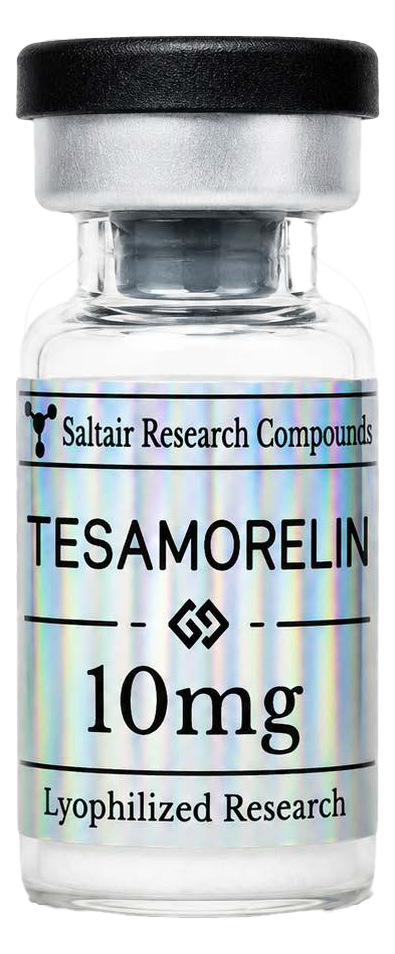
Tesamorelin is a synthetic analog of growth-hormone-releasing hormone (GHRH). Rather than replacing growth hormone directly, it stimulates the pituitary to release the body’s own — a more physiological approach that has carried it all the way to regulatory approval.
What you’re reading about
Tesamorelin (developed as TH9507) is FDA-approved for a specific condition — excess visceral abdominal fat in HIV-associated lipodystrophy — making it one of the few peptides in this library to have completed the full path to approval.
Mechanism
As a GHRH analog, tesamorelin binds pituitary GHRH receptors and prompts pulsatile release of endogenous growth hormone, raising GH and IGF-1 within the body’s own regulatory rhythm.
Research applications
- Visceral fat and metabolic research.
- The GHRH–GH–IGF-1 axis.
- Cognitive and body-composition endpoints.
Clinical outlook
Tesamorelin’s clinical record is substantial. Its pivotal Phase 3 program established efficacy and safety in HIV-associated lipodystrophy (NCT00608023), leading to approval, and further trials have explored metabolic endpoints such as type 2 diabetes (NCT01264497). Researchers continue to investigate GHRH-analog approaches to visceral fat and metabolic health.
Frequently asked questions about Tesamorelin
Straight answers to the questions researchers most often ask. Everything below summarizes published preclinical and clinical literature; it is not medical advice, and these compounds are supplied for laboratory research only.
What is Tesamorelin?
Tesamorelin is a synthetic 44-amino-acid analog of growth-hormone-releasing hormone (GHRH) with a stabilizing trans-3-hexenoic acid group at its N-terminus. It is the only GHRH analog to complete Phase 3 trials and win FDA approval.
Is Tesamorelin FDA approved?
Yes — as Egrifta, approved in 2010 to reduce excess abdominal fat in HIV-associated lipodystrophy. Our Tesamorelin is a research-grade compound for laboratory use and is not the approved pharmaceutical product.
How does Tesamorelin work?
It binds pituitary GHRH receptors and increases the amplitude of the body's own growth-hormone pulses, raising IGF-1 while preserving the natural pulsatile pattern and feedback that continuous GH administration bypasses.
What has Tesamorelin been studied for beyond lipodystrophy?
Visceral fat and liver fat in nonalcoholic fatty liver disease, cognition in older adults and mild cognitive impairment, and body composition in aging. The NAFLD work showed reduced liver fat in a randomized trial.
Tesamorelin vs CJC-1295 — what is the difference?
Both are GHRH analogs. Tesamorelin is the clinically validated one with Phase 3 data and approval; CJC-1295 (no DAC) is a shorter analog whose only registered trial was terminated. Researchers often use Tesamorelin as the reference compound for the class.
How is Tesamorelin stored?
Lyophilized powder is stored cool, dry and dark (frozen for long term); once reconstituted it is refrigerated and, per the clinical product's labeling, used within a short window.