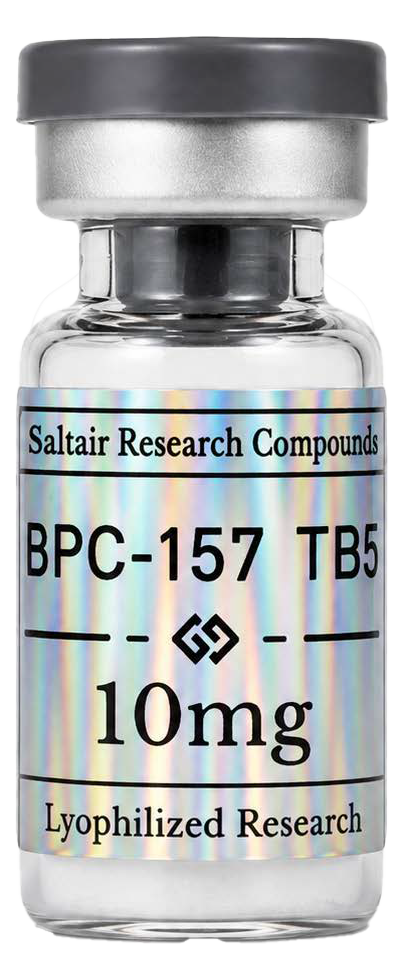
This is a combination of two of the most studied tissue-repair peptides — BPC-157 and TB-500 — supplied together in one preparation. Each has its own full profile; this page explains why they’re so often paired.
What you’re reading about
- BPC-157 — a pentadecapeptide studied for angiogenesis and musculoskeletal/gut repair. Read the BPC-157 profile →
- TB-500 — a Thymosin β-4 fragment studied for actin regulation, cell migration, and repair. Read the TB-500 profile →
The rationale
The two are frequently combined because their mechanisms are complementary: BPC-157 research centers on blood-vessel formation and growth-factor signaling, while TB-500 research centers on cell migration and cytoskeletal dynamics. Together they touch different stages of the tissue-repair process.
Research outlook
As with any combination, the pairing itself has not been studied in dedicated clinical trials — its rationale rests on the research behind each peptide. For the mechanisms, human-trial status, and citations, see the two individual profiles linked above.
Frequently asked questions about BPC-157 + TB-500 (Repair Combo)
Straight answers to the questions researchers most often ask. Everything below summarizes published preclinical and clinical literature; it is not medical advice, and these compounds are supplied for laboratory research only.
What is the BPC-157 and TB-500 combination?
Why are BPC-157 and TB-500 combined?
Their mechanisms are complementary: BPC-157 acts through growth-factor and nitric-oxide pathways, while TB-500 acts through actin regulation and cell migration. Researchers pair them to study repair from two directions at once.
Has the combination itself been studied?
Not in controlled published trials — the evidence base is the two individual literatures. That is an honest limitation: synergy is a hypothesis, not a demonstrated finding.
Is the BPC-157/TB-500 blend FDA approved?
No. Neither peptide is an approved drug, and the blend has no regulatory status. It is supplied for laboratory research only.
What does 10mg mean on the blend?
Total peptide content per vial across both components; the product page lists the split.