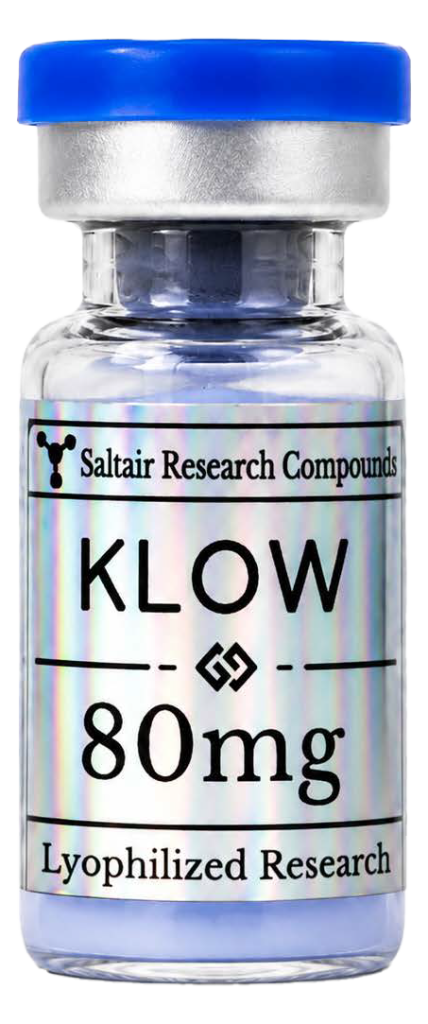
KLOW is not a single peptide but a combination blend — a research “stack” that brings together four peptides studied for tissue repair and anti-inflammatory activity in one preparation.
What you’re reading about
KLOW combines four components:
- GHK-Cu — the copper tripeptide studied for skin and tissue repair. Read the GHK-Cu profile →
- BPC-157 — the pentadecapeptide studied for musculoskeletal and gut repair. Read the BPC-157 profile →
- TB-500 — the Thymosin β-4 fragment studied for cell migration and repair. Read the TB-500 profile →
- KPV — a melanocortin-derived tripeptide studied for anti-inflammatory signaling.
The rationale
The idea behind a blend like KLOW is complementary mechanisms: pairing peptides associated with angiogenesis, cell migration, extracellular-matrix synthesis, and inflammation control, so one preparation engages several arms of the repair process at once.
Research outlook
Because KLOW is a compounded combination, the blend itself has not been the subject of dedicated clinical trials — its rationale rests entirely on the research behind each component, which is why we link those profiles above. The one component without its own profile here is KPV, whose research centers on anti-inflammatory activity in models of gut and skin inflammation.
Frequently asked questions about KLOW (Peptide Repair Blend)
Straight answers to the questions researchers most often ask. Everything below summarizes published preclinical and clinical literature; it is not medical advice, and these compounds are supplied for laboratory research only.
What is KLOW?
KLOW is a combination research blend of four peptides — GHK-Cu, BPC-157, TB-500 and KPV — formulated for tissue-repair and anti-inflammatory research. It is a "stack" in one vial rather than a single compound.
What does each peptide in KLOW do?
Why combine these four peptides?
Because they act on different stages of repair — inflammation control (KPV), cell recruitment and migration (TB-500), growth-factor signaling (BPC-157) and matrix rebuilding (GHK-Cu). The combination has not itself been studied in published trials; the rationale rests on the individual literatures.
Is KLOW FDA approved?
No. None of its four components is an approved drug and the blend itself has no regulatory status. It is supplied for laboratory research only.
What does the 80mg on KLOW mean?
It is the total peptide content of the vial across the four components. See the product page for the component breakdown.
How is KLOW stored?
As with its component peptides: lyophilized, cool, dry and dark; frozen for long-term storage; refrigerated and used within about 30 days once reconstituted. GHK-Cu's copper gives the reconstituted solution a faint blue tint, which is normal.
References
- Melanocortin-derived tripeptide KPV has anti-inflammatory potential in murine models of inflammatory bowel disease
- Dissection of the anti-inflammatory effect of the core and C-terminal (KPV) alpha-melanocyte-stimulating hormone peptides
- Terminal signal: anti-inflammatory effects of α-melanocyte-stimulating hormone related peptides beyond the pharmacophore
- Critical role of PepT1 in promoting colitis-associated cancer and therapeutic benefits of the anti-inflammatory PepT1-mediated tripeptide KPV in a murine model
- The neuroimmunomodulatory peptide alpha-MSH