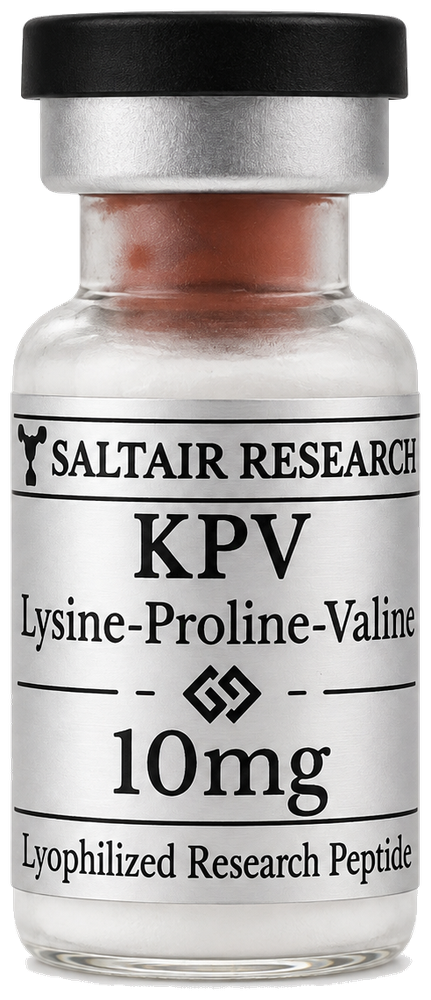
KPV is the tripeptide Lys-Pro-Val — residues 11 to 13 of alpha-melanocyte-stimulating hormone (α-MSH), the 13-amino-acid hormone best known for driving skin pigmentation. The C-terminal fragment turned out to carry α-MSH’s anti-inflammatory and antipyretic activity on its own, without the melanocortin-receptor pigmentation effects. That separation is why a three-residue peptide has a research literature stretching from the 1980s to current drug-delivery work.
What you’re reading about
KPV is small enough to be handled by the body’s di/tripeptide machinery, and that is central to how it works. A 2008 Gastroenterology study showed it is transported into intestinal epithelial and immune cells by PepT1, a transporter that is normally confined to the small intestine but is induced in the colon during inflammatory bowel disease — meaning inflamed tissue takes up more KPV than healthy tissue.
Mechanism under investigation
At nanomolar concentrations KPV inhibits NF-κB and MAP-kinase inflammatory signaling and reduces pro-inflammatory cytokine secretion. The mechanism appears to be largely independent of melanocortin receptors: it retains activity in mice with a non-functional MC1R, and in bronchial epithelium it has been shown to enter the nucleus directly and interfere with importin-mediated nuclear import of the NF-κB p65 subunit. Early work also reported direct antimicrobial effects against Staphylococcus aureus and Candida albicans, though a 2018 study using an acetylated, amidated form found no antimicrobial activity under its conditions — the antimicrobial claim should be read as unsettled.
Research applications
- Colitis and inflammatory-bowel-disease models (DSS, TNBS and T-cell transfer colitis), including oral nanoparticle and rectal hydrogel delivery systems.
- Airway epithelial inflammation — TNF-α and viral-evoked NF-κB signaling, IL-8 and eotaxin secretion.
- Keratinocyte signaling and dermal inflammation.
- Peritonitis and neutrophil-migration models used to dissect α-MSH pharmacology.
- Peptide drug-delivery research, where KPV is a model cargo for hydrogels and targeted nanoparticles.
Clinical outlook
KPV has not entered registered human trials. Its clinical relevance is indirect but real: the parent hormone’s pathway produced FDA-approved melanocortin drugs (afamelanotide, bremelanotide, setmelanotide), and much of the recent KPV work is formulation science — hyaluronic-acid nanoparticles, chitosan/alginate hydrogels — aimed squarely at ulcerative colitis. The peptide’s instability in solution, noted repeatedly in that literature, is one reason delivery vehicles dominate current research. For a laboratory, KPV is a clean, well-mechanized tool for studying NF-κB-driven inflammation without melanocortin-receptor confounds.
Frequently asked questions about KPV (Lysine-Proline-Valine)
Straight answers to the questions researchers most often ask. Everything below summarizes published preclinical and clinical literature; it is not medical advice, and these compounds are supplied for laboratory research only.
What is KPV?
KPV is the tripeptide Lys-Pro-Val — residues 11 to 13 at the C-terminal end of alpha-melanocyte-stimulating hormone (α-MSH). It carries the parent hormone's anti-inflammatory activity without its pigmentation effects.
What does KPV do?
At nanomolar concentrations it inhibits NF-κB and MAP-kinase inflammatory signaling and reduces pro-inflammatory cytokine release. It has been studied most in colitis and inflammatory-bowel-disease models, and also in airway, skin and peritonitis models.
How does KPV work?
Largely independently of melanocortin receptors: it retains activity in mice lacking functional MC1R, and in airway epithelium it enters the nucleus and blocks importin-mediated transport of the NF-κB p65 subunit. In the gut it is carried into cells by the PepT1 transporter, which is up-regulated in inflamed colon.
Is KPV good for gut inflammation?
In mouse colitis models (DSS, TNBS and T-cell transfer), oral or rectal KPV reduced weight loss, inflammatory infiltrates and cytokine expression. Much recent work is on delivery systems — nanoparticles and hydrogels — to overcome its instability in solution. There are no human trials.
Is KPV antimicrobial?
The evidence is mixed. A 2000 study reported direct activity against Staphylococcus aureus and Candida albicans; a 2018 study using an acetylated, amidated KPV found no antimicrobial activity under its conditions. The anti-inflammatory findings are far more consistent.
Is KPV FDA approved?
No. KPV has not entered registered human trials and is supplied for laboratory research only. Its parent pathway did produce approved melanocortin drugs (afamelanotide, bremelanotide, setmelanotide).
KPV vs Melanotan II — what is the difference?
Both derive from α-MSH, but KPV is the three-residue anti-inflammatory tail with essentially no receptor-mediated pigmentation, while Melanotan II is a full-length cyclic agonist that tans skin and affects appetite and sexual function.
References
- PepT1-mediated tripeptide KPV uptake reduces intestinal inflammation Nanomolar NF-κB inhibition; PepT1 transport; oral KPV reduces DSS and TNBS colitis.
- Melanocortin-derived tripeptide KPV has anti-inflammatory potential in murine models of inflammatory bowel disease Effects partially independent of MC1R signaling.
- Dissection of the anti-inflammatory effect of the core and C-terminal (KPV) alpha-melanocyte-stimulating hormone peptides KPV unlikely to act through melanocortin receptors.
- Inhibition of cellular and systemic inflammation cues in human bronchial epithelial cells by melanocortin-related peptides: mechanism of KPV action and a role for MC3R agonists Nuclear import of KPV and blockade of p65RelA translocation.
- Antimicrobial effects of alpha-MSH peptides Original report of activity against S. aureus and C. albicans.
- Structural modification of the tripeptide KPV by reductive "glycoalkylation" of the lysine residue Found no antimicrobial activity for Ac-KPV-NH2 — the counterpoint.
- Orally Targeted Delivery of Tripeptide KPV via Hyaluronic Acid-Functionalized Nanoparticles Efficiently Alleviates Ulcerative Colitis
- alpha-Melanocyte-stimulating hormone, MSH 11-13 KPV and adrenocorticotropic hormone signalling in human keratinocyte cells