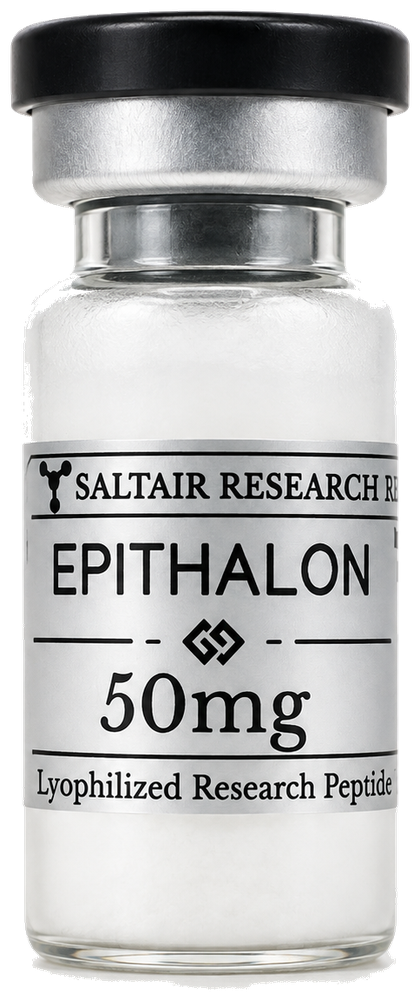
Epithalon — also written Epitalon or Epithalone — is the tetrapeptide Ala-Glu-Asp-Gly (AEDG). It was designed in the 1990s at the St. Petersburg Institute of Bioregulation and Gerontology to reproduce the activity of Epithalamin, a bovine pineal-gland extract that had been studied in Russia since the 1970s. Four amino acids and a molecular weight under 400 make it one of the smallest compounds in longevity research, and one of the most discussed.
What you’re reading about
The compound sits at the center of the “peptide theory of ageing” advanced by Vladimir Khavinson: the idea that aging reflects declining synthesis of short regulatory peptides, and that supplying them can restore tissue-specific gene expression. Readers should know up front that the majority of the primary literature — well over a hundred papers — comes from Khavinson’s institute and collaborators. A 2025 independent review from the Medical University of Warsaw is the most useful entry point precisely because it weighs that body of work from the outside.
Mechanism under investigation
Three findings recur. First, telomerase: in telomerase-negative human fetal fibroblasts, Epithalon induced expression of the catalytic subunit, enzymatic activity, and measurable telomere elongation. Second, pineal and circadian function: in aged rhesus monkeys it produced a roughly three-fold increase in nocturnal melatonin peaks and restored circadian cortisol rhythm. Third, gene regulation: the peptide is cell-penetrating, and a complementary sequence to AEDG has been identified in the interferon-gamma promoter, offering one explanation for its reported effects on aged T-cell function. Antioxidant enzyme activation and reduced chromosomal aberrations are also reported.
Research applications
- Telomerase activity and telomere length in cultured somatic cells.
- Melatonin synthesis, circadian rhythm and pineal aging.
- Lifespan and age-related pathology in rodents and Drosophila, including a transgenic HER-2/neu mouse study reporting extended lifespan and fewer mammary tumors.
- Immunosenescence — thymic lymphocyte proliferation and interferon-gamma expression.
- Retinal degeneration models (Campbell rats with hereditary retinitis pigmentosa).
Clinical outlook
Epithalon has been given to humans in Russian clinical studies going back decades — the pineal extract it mimics was used in geriatric practice there — but none of that work meets the design standards of a modern registered trial, and there are no listings on ClinicalTrials.gov. The 2025 review is explicit that despite the volume of biological data, physico-chemical and structural characterization of the peptide “remains quite limited,” and that its full mechanism is uncertain. For researchers this is a compound with a rich, provocative, and unusually concentrated literature: an excellent subject for independent replication, and not yet the subject of it.
Frequently asked questions about Epithalon (Epitalon)
Straight answers to the questions researchers most often ask. Everything below summarizes published preclinical and clinical literature; it is not medical advice, and these compounds are supplied for laboratory research only.
What is Epithalon?
Epithalon (also spelled Epitalon or Epithalone) is the synthetic tetrapeptide Ala-Glu-Asp-Gly (AEDG), designed in the 1990s at the St. Petersburg Institute of Bioregulation and Gerontology to reproduce the effects of Epithalamin, a bovine pineal-gland extract.
What does Epithalon do?
Studies report telomerase activation and telomere elongation in cultured human cells, restoration of nocturnal melatonin peaks in aged monkeys, extended lifespan and fewer tumors in mice and fruit flies, and immune effects on aged T-cells. Most of these studies come from a single research group.
Does Epithalon lengthen telomeres?
In one 2003 study, adding Epithalon to telomerase-negative human fetal fibroblasts induced telomerase expression and measurable telomere elongation. That is a cell-culture finding; it has not been replicated independently or demonstrated in humans.
Is Epithalon FDA approved?
No. Epithalon is not approved by the FDA or EMA and has no listings on ClinicalTrials.gov. It has been used in Russian clinical practice historically, but not under modern trial standards. It is supplied here for laboratory research.
Is there human research on Epithalon?
Russian studies going back decades report use in elderly patients, including in retinal degeneration, but none is a modern registered, placebo-controlled trial. A 2025 independent review notes the volume of biological data is large while structural and physico-chemical characterization remains limited.
Epithalon vs melatonin — what is the relationship?
Epithalon appears to act upstream of melatonin: in aged animals it increased the pineal gland's own melatonin production and restored its day–night rhythm. It is not itself a melatonin analog.
How is Epithalon stored?
As a small, stable tetrapeptide it stores well lyophilized — cool, dry, dark, frozen long-term — and reconstituted solution is refrigerated and used within about a month.
References
- Overview of Epitalon — Highly Bioactive Pineal Tetrapeptide with Promising Properties Independent (Warsaw) review of 25 years of in vitro, in vivo and in silico work.
- Epithalon peptide induces telomerase activity and telomere elongation in human somatic cells
- Epithalon decelerates aging and suppresses development of breast adenocarcinomas in transgenic her-2/neu mice Mean lifespan +13.5%; fewer mammary tumors and lung metastases.
- Peptides and Ageing Monograph-length review; the "peptide theory of ageing"; melatonin/cortisol rhythm restoration in aged rhesus monkeys.
- Peptide Ala-Glu-Asp-Gly and interferon gamma: their role in immune response during aging Complementary AEDG-binding sequence reported in the interferon-gamma promoter.