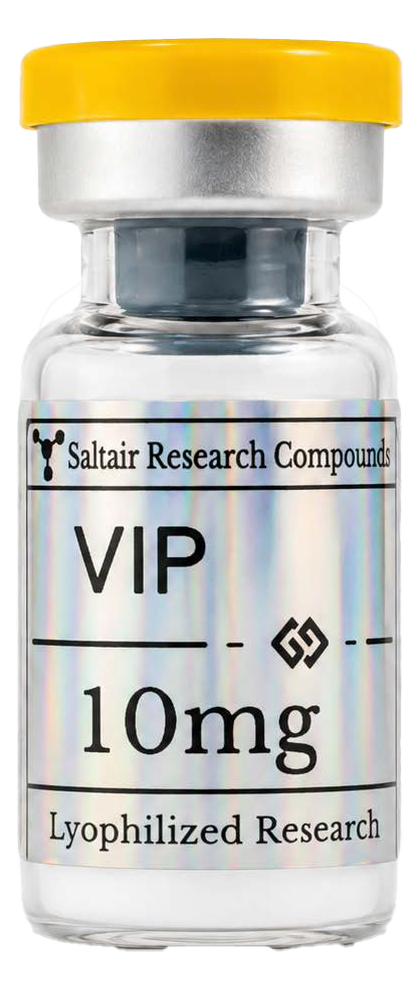
VIP — vasoactive intestinal peptide — is a 28-amino-acid neuropeptide found throughout the nervous, immune, and cardiovascular systems. As its name suggests, it relaxes blood vessels and airways, and it plays broad roles in inflammation and circadian rhythm.
What you’re reading about
In clinical research, synthetic VIP is known as aviptadil — the same peptide, developed as an investigational drug. Much of the human trial evidence for VIP is filed under that name.
Mechanism
VIP binds VPAC receptors to relax smooth muscle (vasodilation and bronchodilation), modulate immune signaling, and protect certain cells under stress — a wide reach that has drawn interest across pulmonary and inflammatory research.
Research applications
- Pulmonary and respiratory research.
- Inflammation and immune modulation.
- Vascular and neuroendocrine signaling.
Clinical outlook
VIP reached prominent human research as aviptadil, studied in Phase 2/3 trials for critical respiratory failure — most visibly in severe COVID-19 (NCT04311697, NCT06729606). That work put a decades-old neuropeptide back at the center of pulmonary research and continues to shape how VIP signaling might be applied clinically.
Frequently asked questions about VIP (Vasoactive Intestinal Peptide)
Straight answers to the questions researchers most often ask. Everything below summarizes published preclinical and clinical literature; it is not medical advice, and these compounds are supplied for laboratory research only.
What is VIP (vasoactive intestinal peptide)?
VIP is a 28-amino-acid neuropeptide found throughout the nervous, immune and cardiovascular systems. It relaxes blood vessels and airways, regulates gut secretion and motility, and has broad anti-inflammatory and circadian roles.
What is aviptadil?
Aviptadil is the name for synthetic VIP when developed as an investigational drug. It has been studied in Phase 2/3 trials for critical respiratory failure, including severe COVID-19, and earlier for erectile dysfunction in combination products.
How does VIP work?
VIP binds VPAC1 and VPAC2 receptors, raising cyclic AMP in target cells. In the lung it protects alveolar type II cells, reduces cytokine release and relaxes airway smooth muscle; in the immune system it shifts responses toward tolerance.
Is VIP FDA approved?
No. Aviptadil has been through registered trials but is not approved in the US; a VIP-containing combination is approved in some countries for erectile dysfunction. The research peptide sold here is for laboratory use only.
What is VIP studied for?
Acute respiratory distress syndrome, pulmonary hypertension, sarcoidosis, inflammatory and autoimmune conditions, and circadian-rhythm biology — VIP is the principal signal that synchronizes the brain's master clock.
What is the half-life of VIP?
Very short — on the order of one to two minutes in circulation, because it is rapidly degraded by peptidases. That is why clinical work has used continuous infusion or inhaled delivery.
References
- The Use of IV Vasoactive Intestinal Peptide (Aviptadil) in Patients With Critical COVID-19 Respiratory Failure: Results of a 60-Day Randomized Controlled Trial
- Vasoactive Intestinal Peptide in Checkpoint Inhibitor-Induced Pneumonitis
- Inhalation of vasoactive intestinal peptide in pulmonary hypertension
- Investigation of vasoactive intestinal peptide expression and significance in a congenital diaphragmatic hernia animal model
- Brief Report: Rapid Clinical Recovery From Critical Coronavirus Disease 2019 With Respiratory Failure in a Pregnant Patient Treated With IV Vasoactive Intestinal Peptide