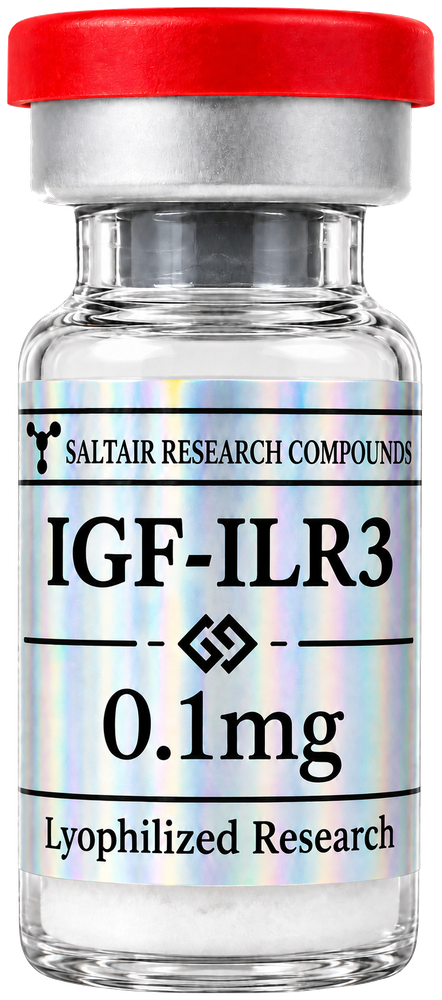
IGF-1 LR3 (Long R3 IGF-1, LR3IGF-I) is an engineered analog of human insulin-like growth factor-1 designed in the early 1990s by Francis, Ballard and colleagues at the CSIRO in Adelaide. Two changes distinguish it from native IGF-1: a 13-amino-acid N-terminal extension, and an arginine substituted for glutamate at position 3 — hence “Long” and “R3”. Together they give the molecule a property that defines its research use: it barely binds the IGF-binding proteins that normally sequester IGF-1.
What you’re reading about
Native IGF-1 in circulation is almost entirely bound to IGFBPs — chiefly IGFBP-3 — which extend its half-life but also gate how much reaches receptors. LR3’s Arg3 substitution reduces IGFBP affinity dramatically, so more of the free peptide is available to act. The trade-off, documented in the original characterization, is roughly three-fold weaker binding to the type-1 IGF receptor itself. In cell lines that secrete binding proteins, LR3 comes out well ahead of IGF-1 in potency; in cells that don’t, it can be less potent. That binding-protein dependence is the key to reading every LR3 study.
Mechanism under investigation
LR3 signals through the IGF-1 receptor, activating the PI3K/Akt and MAPK cascades that drive cell proliferation, survival, protein synthesis and differentiation. In the 1992 rat work it was about 2.5-fold more potent than IGF-1 at reversing dexamethasone-induced catabolism, increasing nitrogen retention and reducing muscle protein breakdown. In lung fibroblasts it reached half-maximal proliferation at 0.6 nM versus 1.5 nM for IGF-1, and in bovine satellite cells it stimulates proliferation in an EGFR-dependent manner.
Research applications
- Serum-free cell culture — LR3 is a standard recombinant-protein and cell-line media supplement precisely because binding proteins in serum don’t neutralize it.
- IGF-1 receptor signaling and IGFBP biology, where it serves as a “binding-protein-independent” comparator.
- Skeletal-muscle, satellite-cell and catabolic-state models.
- Growth-axis feedback: LR3 suppresses endogenous GH, IGF-1 and IGFBP-3 secretion, a useful tool for studying the somatotropic loop.
Clinical outlook
There are no human clinical trials of IGF-1 LR3, and the animal literature is more mixed than its reputation suggests. It stimulates growth in rats but, in a 1997 pig study, reduced weight gain and feed intake while suppressing plasma GH, IGF-1 and IGFBP-3 — a reminder that a molecule which evades binding proteins also evades the body’s buffering. In guinea pigs it enlarged gut, kidney, spleen and adrenal weight without changing overall growth. The honest summary is that LR3 is a superb reagent — its commercial life is in bioprocessing and cell culture — and a species-dependent, incompletely characterized in vivo agent. The clinically developed IGF-1 is the native protein, mecasermin, approved for severe primary IGF-1 deficiency; LR3 has never followed that path.
Frequently asked questions about IGF-1 LR3
Straight answers to the questions researchers most often ask. Everything below summarizes published preclinical and clinical literature; it is not medical advice, and these compounds are supplied for laboratory research only.
What is IGF-1 LR3?
IGF-1 LR3 (Long R3 IGF-1) is an 83-amino-acid engineered analog of insulin-like growth factor-1 with a 13-amino-acid N-terminal extension and an arginine substituted at position 3. Designed at the CSIRO in Australia in the early 1990s, it is widely used as a cell-culture reagent.
What is the difference between IGF-1 and IGF-1 LR3?
LR3 barely binds the IGF-binding proteins (IGFBPs) that normally sequester IGF-1, so more free peptide reaches receptors — but it binds the IGF-1 receptor itself about three times more weakly. In binding-protein-rich systems it is more potent than IGF-1; in systems without binding proteins it can be less potent.
What is IGF-1 LR3 used for in research?
Serum-free cell culture and bioprocessing (its main commercial use), IGF-1 receptor and binding-protein biology, skeletal-muscle and satellite-cell proliferation studies, and catabolic-state models in animals.
Is IGF-1 LR3 FDA approved?
No. IGF-1 LR3 has never entered human clinical trials. The approved form of IGF-1 is native mecasermin (Increlex), for severe primary IGF-1 deficiency in children.
Does IGF-1 LR3 build muscle?
In rats it increased nitrogen retention and reduced muscle-protein breakdown about 2.5-fold more potently than IGF-1. But in pigs it reduced growth and suppressed the animals' own GH, IGF-1 and IGFBP-3 — the effect is species-dependent, and there is no human evidence.
What is the half-life of IGF-1 LR3?
Longer than native IGF-1 in circulation — reported at roughly 20–30 hours in animal work — because it is not cleared through the binding-protein system. Native IGF-1 bound to IGFBP-3 has a half-life of about 12–15 hours; free IGF-1 is cleared in minutes.
References
- Novel recombinant fusion protein analogues of insulin-like growth factor (IGF)-I indicate the relative importance of IGF-binding protein and receptor binding for enhanced biological potency Original design and characterization of Long [Arg3]-IGF-I; potency depends on binding-protein presence.
- Insulin-like growth factor-I (IGF-I) and especially IGF-I variants are anabolic in dexamethasone-treated rats ~2.5-fold more potent than IGF-I despite 3-fold weaker receptor binding.
- Long [R3] insulin-like growth factor-I reduces growth, plasma growth hormone, IGF binding protein-3 and endogenous IGF-I concentrations in pigs Counterpoint: growth inhibition and GH-axis suppression in pigs.
- Long R3 insulin-like growth factor-I (IGF-I) infusion stimulates organ growth but reduces plasma IGF-I, IGF-II and IGF binding protein concentrations in the guinea pig
- Regulation of insulin-like growth factor (IGF)-binding protein expression by growth factors and cytokines alters IGF-mediated proliferation of postnatal lung fibroblasts Half-maximal proliferation at 0.6 nM (LR3) vs 1.5 nM (IGF-I).
- Epidermal growth factor receptor is required for estradiol-stimulated bovine satellite cell proliferation LR3-IGF-1 satellite-cell proliferation is EGFR-dependent.