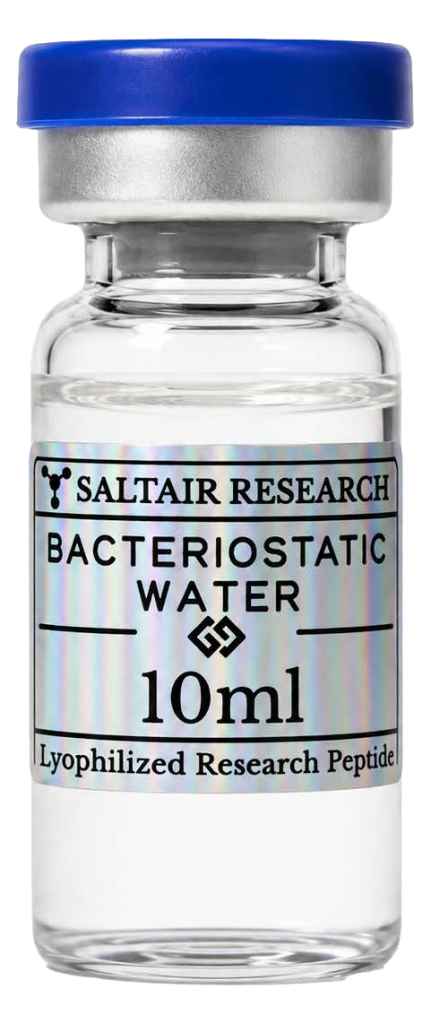
Bacteriostatic water is not a peptide — it’s the solvent used to reconstitute lyophilized (freeze-dried) research peptides into solution. It’s included here because handling it correctly is part of sound laboratory practice.
What you’re reading about
Bacteriostatic water is sterile water containing 0.9% benzyl alcohol. The benzyl alcohol is bacteriostatic — it inhibits bacterial growth — which is what lets a reconstituted vial be drawn from multiple times in a research setting, rather than discarded immediately as plain sterile water would require.
How it’s used
In the lab, a measured volume of bacteriostatic water is introduced into a vial of lyophilized peptide, dissolving the powder into a stable working solution. The volume used sets the concentration. It’s chosen specifically for its preservative property and multi-use stability.
Handling notes
Bacteriostatic water is a supporting laboratory material — its role is purely as a reconstitution medium for research compounds. See the Peptides 101 primer for how reconstitution fits into the broader research workflow.
Frequently asked questions about Bacteriostatic Water
Straight answers to the questions researchers most often ask. Everything below summarizes published preclinical and clinical literature; it is not medical advice, and these compounds are supplied for laboratory research only.
What is bacteriostatic water?
Bacteriostatic water is sterile water containing 0.9% benzyl alcohol as a preservative. The benzyl alcohol inhibits bacterial growth, which is what allows a reconstituted vial to be stored and drawn from over days or weeks.
What is the difference between bacteriostatic water and sterile water?
Sterile water for injection has no preservative and is intended for single use — once opened it should be discarded. Bacteriostatic water's 0.9% benzyl alcohol makes multi-use vials possible, which is why it is the standard reconstitution solvent for lyophilized peptides.
How is bacteriostatic water used to reconstitute peptides?
In laboratory practice the water is added slowly down the inside wall of the peptide vial (never sprayed onto the powder), then the vial is gently swirled — not shaken — until the powder dissolves. The volume chosen sets the final concentration.
How long does bacteriostatic water last once opened?
The manufacturer convention is 28 days after first puncture, refrigerated. Reconstituted peptides are generally treated the same way.
Can bacteriostatic water be used with every peptide?
It is appropriate for the large majority. A few compounds are sensitive to benzyl alcohol or need acidic or buffered solvents; those are noted on their product or profile pages.