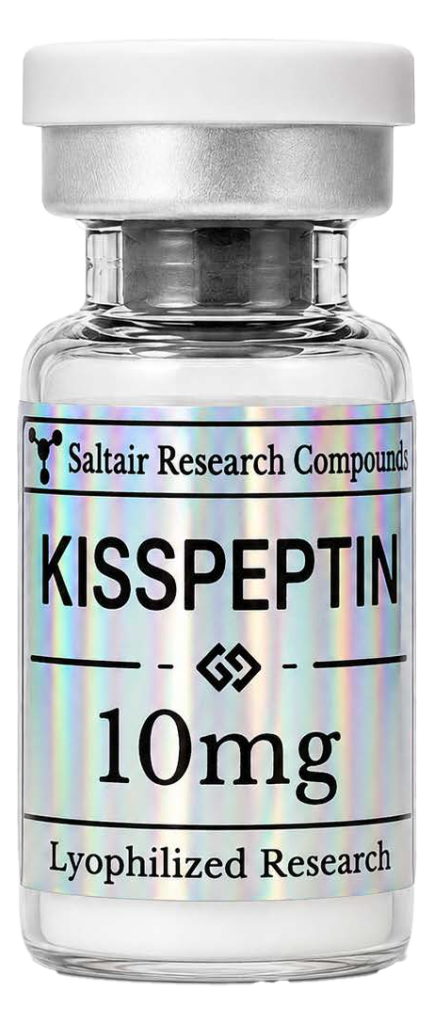
Kisspeptin sits at the very top of the reproductive hormone cascade. It is the master signal that tells the brain to begin the chain of events controlling puberty, fertility, and reproductive function.
What you’re reading about
Kisspeptin (its active fragment is often called KP-10) acts on the hypothalamus to trigger release of GnRH, the hormone that starts the reproductive axis. It is a genuine focus of modern reproductive endocrinology.
Mechanism
Kisspeptin binds the KISS1R receptor on GnRH neurons, initiating the hypothalamic–pituitary–gonadal (HPG) axis. Its discovery reshaped the understanding of how puberty and fertility are switched on.
Research applications
- Fertility and reproductive endocrinology.
- Puberty and HPG-axis regulation.
- Metabolic–reproductive signaling.
Clinical outlook
Kisspeptin has an active human-research program. Phase 3 studies have examined hypothalamic responsiveness across age (NCT03315325) and kisspeptin’s effects on hormone secretion (NCT03771326). Researchers see real potential for kisspeptin-based approaches in fertility and reproductive medicine, making it one of the more clinically promising neuropeptides in its field.
Frequently asked questions about Kisspeptin
Straight answers to the questions researchers most often ask. Everything below summarizes published preclinical and clinical literature; it is not medical advice, and these compounds are supplied for laboratory research only.
What is kisspeptin?
Kisspeptin is a family of neuropeptides encoded by the KISS1 gene that sit at the top of the reproductive hormone axis: they trigger GnRH release from the hypothalamus, which in turn drives LH and FSH. The 10-amino-acid fragment KP-10 carries full activity.
What does kisspeptin do?
It initiates puberty and regulates fertility, ovulation and sex-steroid production in both sexes. Mutations in the kisspeptin receptor cause absent puberty, which is how its central role was discovered in 2003.
Has kisspeptin been tested in humans?
Yes, extensively. Kisspeptin has been given in dozens of human physiology studies and Phase 2/3 trials, including work on triggering egg maturation in IVF, hypothalamic amenorrhea, and sexual-desire and reward pathways in the brain.
Is kisspeptin FDA approved?
No. Kisspeptin is an investigational compound with an active human-research program but no approved product. It is supplied here for laboratory research.
What is the difference between kisspeptin-10 and kisspeptin-54?
Both are cleavage products of the same precursor. KP-54 is the main circulating form with a longer half-life; KP-10 is the minimal active fragment. Research products are usually KP-10.
What is the half-life of kisspeptin?
Short: about four minutes for KP-10 and roughly 28 minutes for KP-54 in human plasma studies. Effects on LH release outlast the peptide because of downstream GnRH signaling.
References
- Reproductive functions of Kisspeptin/KISS1R Systems in the Periphery
- Kisspeptin and KISS1R: a critical pathway in the reproductive system
- The Role of Kisspeptin in the Control of the Hypothalamic-Pituitary-Gonadal Axis and Reproduction
- Kisspeptin signaling in astrocytes modulates the reproductive axis
- Neuropeptide derivatives to regulate the reproductive axis: Kisspeptin receptor (KISS1R) ligands and neurokinin-3 receptor (NK3R) ligands